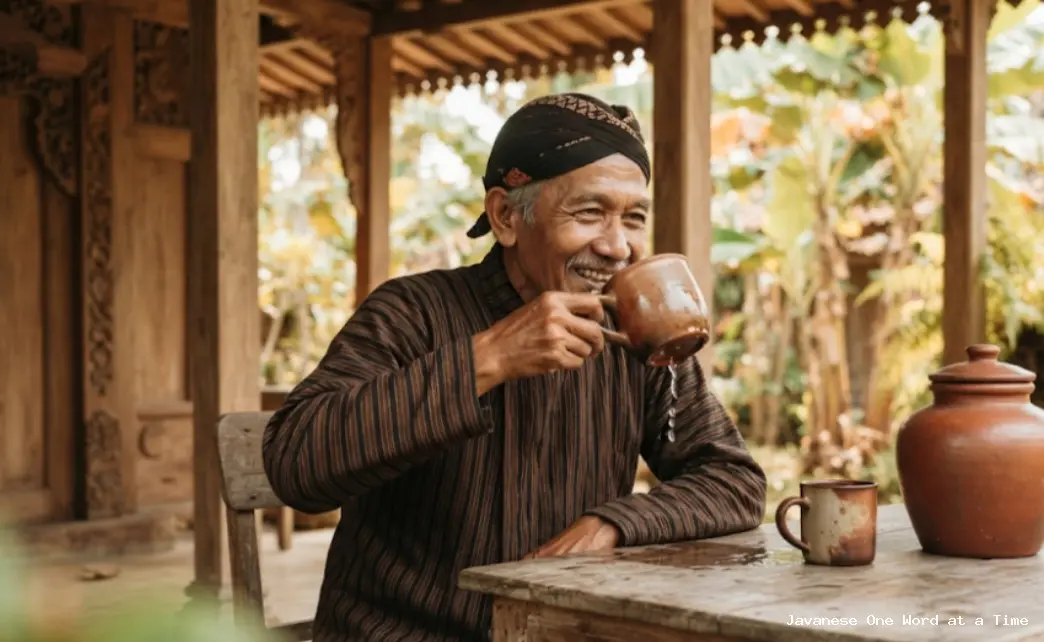
In the Javanese One Word at a Time series, we explore individual Javanese words beyond their dictionary meanings. This time, the word is ngombe, a common Javanese word meaning “to drink.”
For learners unfamiliar with Javanese, ngombe is a useful word to recognize because drinking is an ordinary activity that frequently appears in everyday conversation. You may encounter it when someone talks about drinking water, having a drink, asking another person whether they have had something to drink, or describing what someone is doing.
Understanding ngombe also provides a small introduction to how Javanese verbs can appear in natural conversation. Rather than memorizing the English equivalent alone, it is more useful to see how the word functions in complete sentences and everyday situations.

WHAT DOES “NGOMBE” MEAN?
The Javanese word ngombe means “to drink” in English.
Its basic meaning refers to the action of taking a liquid into the mouth and swallowing it. Depending on the sentence, it can refer to drinking water or another beverage.
For example:
Javanese:
“Ngombe banyu.”
English:
“Drink water.”
The word can also appear in longer sentences:
Javanese:
“Aku arep ngombe.”
English:
“I want to drink.”
Here, ngombe describes the action that the speaker intends to do.
As with many vocabulary items, the exact interpretation depends on the surrounding sentence and situation. Therefore, learners should not assume that every occurrence of ngombe needs to be translated in exactly the same grammatical way in English.
HOW TO PRONOUNCE “NGOMBE”?
For an English-speaking learner, ngombe may initially look unfamiliar because of the opening ng- sound.
A practical approximation is:

ngombe → ngom-beh
The first sound is similar to the ng sound at the end of the English word “sing,” except that in ngombe, the sound occurs at the beginning of the word.
The second part, -be, is pronounced as a separate syllable. The pronunciation can vary somewhat depending on a speaker’s accent and regional speech habits, so learners should treat this approximation as a learning aid rather than a strict phonetic transcription.
Listening to natural Javanese speech is the best way to become comfortable with the sound.
HOW IS “NGOMBE” USED IN JAVANESE?
Ngombe is used to talk about drinking. In everyday situations, it can appear when someone describes an action, asks about drinking, or tells someone to drink.
For example, a person might use ngombe when talking about what they are doing:
Javanese:
“Aku lagi ngombe.”
English:
“I am drinking.”
It can also be used when discussing an intention:
Javanese:
“Aku arep ngombe.”
English:
“I am going to drink.”
The surrounding words are important because they help establish the time, intention, or situation associated with the action.
Another useful point for learners is that ngombe is a verb. It names an action rather than an object. The object being consumed can be mentioned separately.

For instance:
Javanese:
“Dheweke ngombe banyu.”
English:
“He/She drinks water.”
Here, ngombe is the action, while banyu means “water.”
JAVANESE EXAMPLES
Here are several natural examples showing how ngombe can function in sentences.
Example 1
Javanese:
“Aku ngombe banyu.”
English:
“I drink water.”
This simple sentence introduces ngombe together with banyu, meaning “water.”
Example 2
Javanese:
“Aku lagi ngombe.”
English:
“I am drinking.”
The word lagi helps indicate that the action is currently taking place.
Example 3
Javanese:
“Dheweke arep ngombe.”
English:
“He/She is going to drink.”
In this sentence, arep expresses an intention or upcoming action, while ngombe identifies the action itself.
Example 4
Javanese:
“Wis ngombe durung?”
English:
“Have you had something to drink yet?”
This kind of expression can occur in an everyday conversational setting. The meaning comes from the combination of the words rather than from ngombe alone.
Example 5
Javanese:
“Yen kesel, ngombe dhisik.”
English:
“If you are tired, have a drink first.”
This example shows how ngombe can be used when giving a suggestion or instruction in an informal context.
JAVANESE SPEECH LEVELS
One important feature of Javanese is its system of speech levels. Speakers can choose different vocabulary depending on factors such as familiarity, social relationship, and the level of respect appropriate to a situation.
Ngombe is associated with Ngoko, the less formal level of Javanese commonly used in familiar or informal interactions.
This means learners should pay attention to who they are speaking with and the social setting before using vocabulary they have learned.
It is also important not to invent or assume a formal equivalent simply because English has one word for “drink.” Javanese vocabulary choices can depend on speech level and context, so a learner should learn the appropriate form as part of a larger set of vocabulary rather than treating individual words as completely interchangeable.
For beginners, the key point is simple: ngombe is useful to recognize and use in appropriate informal or familiar contexts.
THE CULTURE BEHIND THE WORD
There is no need to attach a special cultural story or historical explanation to ngombe simply because it means “to drink.” Its importance for learners is more practical: drinking is an everyday activity, so the word naturally appears in ordinary communication.
Learning a word such as ngombe can nevertheless help international learners understand how Javanese works in real conversations. Everyday verbs are particularly useful because they allow learners to move beyond isolated vocabulary and begin forming simple sentences.
For example, once a learner knows ngombe, they can begin recognizing expressions about what someone is drinking, whether someone is drinking, or when someone intends to drink.
The cultural lesson is therefore less about a special tradition associated with the word and more about understanding that Javanese vocabulary is connected to social context and speech level.
A SHORT JAVANESE CONVERSATION
Here is a short informal conversation using ngombe.
A: “Kowe arep ngombe apa?”
B: “Aku arep ngombe banyu.”
English Translation:
A: “What are you going to drink?”
B: “I am going to drink water.”
In this conversation, ngombe appears twice, but its meaning becomes clearer from the surrounding words.
The first speaker asks about the beverage the second person intends to drink. The second speaker answers by mentioning banyu, or water.
This is a useful pattern for beginners because it demonstrates how one vocabulary item can be reused naturally in a short exchange.
RELATED JAVANESE WORDS
When learning ngombe, it can be helpful to recognize a few closely connected words.
- banyu — water
- apa — what
- aku — I/me
- dheweke — he/she
- arep — intend to / going to
- lagi — currently / in the process of
- wis — already
- durung — not yet
These words are not synonyms for ngombe. Instead, they can appear around it and help learners construct or understand sentences involving drinking.
For example, combining familiar vocabulary can make the meaning of a sentence much easier to recognize:
“Aku lagi ngombe banyu.”
A learner who knows aku, lagi, ngombe, and banyu can understand the sentence as “I am drinking water,” even without translating every word individually.
REMEMBER THIS JAVANESE WORD
The most important point to remember is that ngombe means “to drink” in Javanese.
It is a verb associated with Ngoko, so context matters when deciding whether it is appropriate in conversation. The best way to learn ngombe is not simply to memorize its English meaning, but to practice recognizing it in complete sentences and everyday exchanges.
Once you are familiar with ngombe, try using it alongside simple words such as aku, banyu, arep, and lagi. This will help turn a single vocabulary item into practical Javanese communication.