If you are learning Javanese, ngombe is a useful expression to recognize because it can appear in ordinary conversations about drinking. However, translating it simply as “drink” does not tell an international learner everything they need to know.
In Javanese, the meaning of a word is only part of the picture. The situation, relationship between speakers, and level of speech can influence whether an expression sounds natural in a particular conversation.
Ngombe is generally associated with informal Javanese, especially ngoko. For that reason, understanding when it fits is just as important as remembering its English translation.

This guide focuses entirely on ngombe, explaining what it means, how it works in everyday sentences, and what learners should consider when using it.
WHAT DOES “NGOMBE” MEAN?
Javanese:
ngombe
English:
to drink
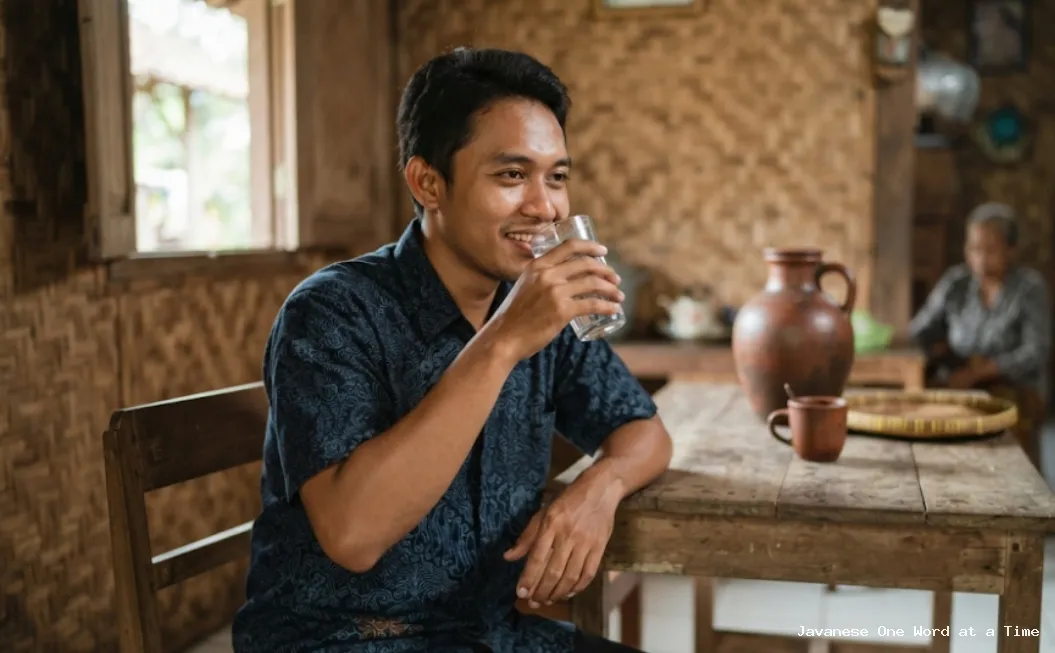
The basic meaning of ngombe is to drink or consume a liquid.
For example:
Aku ngombe banyu.
A natural English translation would be:
I am drinking water.
Depending on the surrounding sentence and context, ngombe can describe an action that is happening, an action someone intends to do, or an action someone regularly does.
The important point is that ngombe itself refers to the act of drinking. Its interpretation does not normally require a special figurative meaning.

For an international learner, therefore, the easiest starting point is:
ngombe = to drink
The next step is understanding how that expression fits into an actual Javanese conversation.
LITERAL VS. NATURAL MEANING
The literal meaning of ngombe and its natural conversational meaning are very close.
Literally, it refers to drinking. In natural English, it can usually be translated as:
- to drink
- drink
- drinking
The exact English wording depends on the sentence.
For example:
Aku arep ngombe.
A natural translation is:
I want to have a drink.
The English expression “have a drink” sounds more conversational in this context, even though the basic action described by ngombe is simply drinking.
This is an important distinction for learners: a natural translation does not always need to copy the grammatical structure of the Javanese sentence word for word.
WHEN DO JAVANESE SPEAKERS USE “NGOMBE”?
Ngombe is used when talking about drinking in an informal conversational setting.
It can be used when someone talks about their own drinking, asks another person about drinking, or describes another person’s action.
For example:
Aku arep ngombe.
The speaker is saying that they want to drink.
Another example is:
Kowe wis ngombe?
This can naturally be understood as:
Have you had anything to drink?
The expression therefore works in simple everyday situations. It does not need to be part of a fixed idiom to be useful.
However, learners should pay attention to the relationship between speakers. Ngombe is associated with ngoko, so it is most naturally understood within an informal speech setting.
WHO TYPICALLY USES “NGOMBE”?
The expression is appropriate when the speaker is using a level of Javanese in which ngoko vocabulary is expected.
This can include familiar, informal interactions. For example, close friends or people who normally speak to each other in ngoko may use ngombe naturally.
It is not necessary to interpret this as meaning that ngombe is inherently rude. Rather, it belongs to a particular speech level.
That distinction matters.
A learner who sees ngombe = drink in a vocabulary list might assume the word can be used in every situation. In practice, Javanese speakers consider the social setting when selecting vocabulary.
JAVANESE SPEECH LEVEL AND POLITENESS
One of the most useful things to remember about ngombe is its relationship with ngoko.
Javanese has different speech levels, and vocabulary can change depending on the level being used. Ngombe is associated with the ngoko level.
A more respectful expression for the same general action is ngunjuk, but that does not mean the two words should simply be swapped without considering the rest of the sentence.
For example, when speaking casually:
Kowe wis ngombe?
The use of ngombe fits the informal setting.
In a more respectful interaction, a speaker may use vocabulary appropriate to krama instead.
For international learners, the practical lesson is simple:
Use “ngombe” when the surrounding conversation is appropriately informal or uses ngoko.
The choice of speech level is about the relationship and situation, not simply about whether one word is “good” and another is “bad.”
EXAMPLES IN CONTEXT
Example 1: Talking About Yourself
Aku ngombe banyu.
Natural English:
I am drinking water.
Here, ngombe describes the speaker’s own action. The sentence is straightforward and informal.
Example 2: Asking Someone
Kowe wis ngombe?
Natural English:
Have you had anything to drink?
In this example, ngombe appears in a question. The sentence is conversational and fits an informal interaction.
Example 3: Talking About Someone Else
Dheweke lagi ngombe.
Natural English:
He is drinking. / She is drinking.
The context determines who dheweke refers to. The important point for this article is that ngombe describes the person’s current action.
These examples show that ngombe can function naturally in several basic conversational situations while retaining its core meaning.
COMMON MISTAKES WITH “NGOMBE”
The most common mistake for beginners is not understanding the role of speech level.
A learner may memorize:
ngombe = drink
and then use it with everyone.
That can miss an important part of Javanese communication. Because ngombe is associated with ngoko, the surrounding conversation should also be appropriate for that level.
Another mistake is assuming that every occurrence of ngombe has exactly the same English translation.
The core meaning remains “drink,” but English may use different natural expressions depending on context:
Aku arep ngombe.
I want to have a drink.
or:
Aku lagi ngombe.
I am drinking.
The difference comes from the sentence and context, not from a completely different meaning of ngombe.
CULTURAL CONTEXT
The cultural aspect directly relevant to ngombe is its place within Javanese speech-level usage.
There is no need to attach an elaborate cultural story or claimed historical origin to the expression. For learners, the useful cultural point is simply that Javanese speakers may select vocabulary according to social relationships and levels of politeness.
Consequently, understanding ngombe involves more than memorizing an English equivalent. A learner should also recognize that the word belongs naturally to an informal ngoko context.
SHORT CONVERSATION
Javanese:
A: Kowe wis ngombe?
B: Wis. Aku ngombe banyu.
A: Oh, ya wis.
English Translation:
A: Have you had anything to drink?
B: Yes. I drank some water.
A: Oh, all right.
The conversation is intentionally simple because the goal is to show ngombe in a natural informal exchange.
The first speaker uses ngombe to ask whether the other person has drunk something. The second speaker uses it again to describe their own action.
RELATED EXPRESSIONS
Because this article focuses on one expression, the most relevant comparison is the speech-level distinction surrounding ngombe.
Ngombe is associated with ngoko, while ngunjuk is used in a more respectful speech-level context.
The important lesson is not to memorize a long list of alternatives. Instead, remember that ngombe belongs naturally to informal Javanese usage and should be understood together with the speech level of the conversation.
FINAL TAKEAWAY
Ngombe means “to drink” and is used to describe the act of drinking in Javanese.
Its literal and natural meanings are closely related, so there is no major figurative meaning that learners need to memorize. What deserves more attention is its social and grammatical context.
Because ngombe is associated with ngoko, it is most naturally used in informal Javanese interactions where that speech level is appropriate.
For an international learner, the key idea is therefore:
Ngombe means “to drink,” but knowing when to use it is just as important as knowing what it means.
Once you understand that connection between the expression and its conversational setting, ngombe becomes much easier to recognize and use naturally.