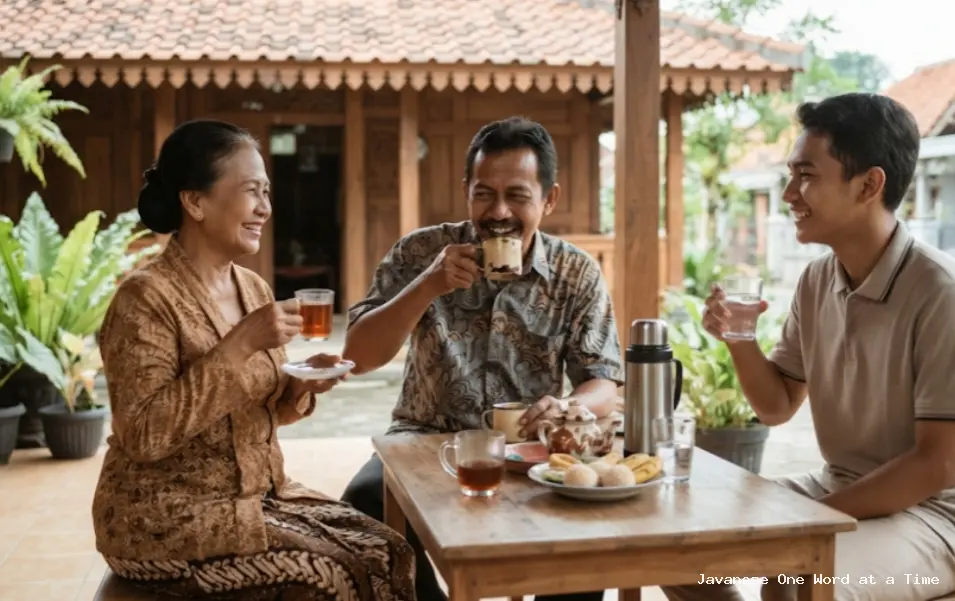
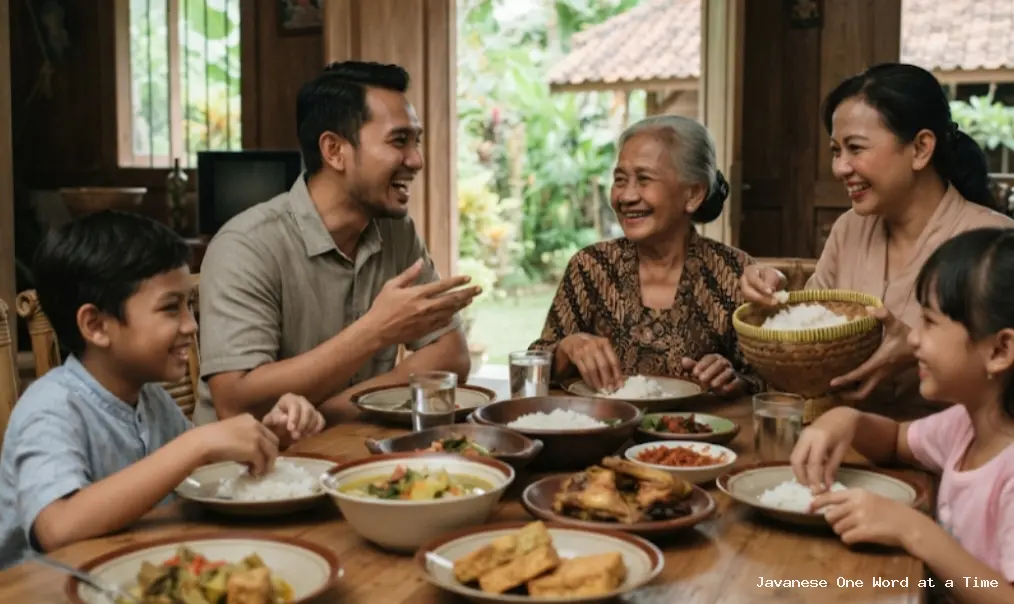
Food is an important part of everyday life in many cultures, and Javanese culture is no exception. One simple Javanese word that opens a wider window into daily life is mangan.
At its most basic level, mangan means “to eat.” However, understanding mangan only as an English equivalent misses an opportunity to see how eating can connect with family life, social interaction, hospitality, language, and cultural values.
In Javanese contexts, eating is often more than a private biological activity. Meals can create opportunities for people to spend time together, communicate, and maintain social relationships. At the same time, the way people talk about eating can reflect the social context in which Javanese is being used.
This article explores mangan as a cultural topic while keeping in mind that Javanese communities are diverse. Customs, expectations, and everyday habits can vary according to family, region, generation, and social setting.
WHAT IS “MANGAN”?
Mangan is a common Javanese verb meaning “to eat.” It refers to the ordinary act of consuming food, but the word also appears naturally in conversations about everyday activities.
For someone learning Javanese, mangan is therefore a useful example of how vocabulary can be connected to culture. A simple verb can occur in conversations about meals, family routines, invitations, daily schedules, and social activities.
The cultural significance comes not from the word alone, but from what eating represents in everyday social life.
In many Javanese contexts, food is closely connected with interaction. Someone may ask whether another person has eaten, offer food, or invite someone to eat. Such expressions can function not only as practical communication but also as part of ordinary social interaction.
It is important, however, not to assume that every Javanese speaker uses food-related expressions in exactly the same way. Language habits differ between communities and individuals.
HISTORICAL OR CULTURAL BACKGROUND
Eating has naturally been part of human life in Java for centuries, but mangan itself should not be treated as the name of one specific traditional ceremony or historical institution.
Instead, it is more useful to understand mangan through the everyday cultural importance of food and meals.
Javanese society has developed a wide range of food traditions and culinary practices. However, these traditions are not identical across the island. Java contains different regions and communities, each with their own local foods, habits, and ways of organizing everyday life.
Consequently, mangan provides a broad cultural entry point rather than representing one single historical tradition.
The importance of eating can also be seen in the social role of meals. Depending on the household and situation, eating may be an individual routine or an opportunity for family members, friends, neighbors, or other members of a community to spend time together.
This social dimension helps explain why food can have significance beyond nutrition.
HOW IT IS UNDERSTOOD OR PRACTICED
In everyday life, mangan can be understood quite simply: people eat when they need or want to eat. Yet the circumstances surrounding a meal can carry social meaning.
For example, sharing food can create an informal opportunity for conversation. Offering food to another person can also be part of hospitality. In some households, meals may be associated with family routines and time spent together.
At the same time, eating practices are not necessarily the same everywhere.
A meal in a family home may be different from eating with friends, attending a community gathering, or having food in a modern restaurant. Younger generations may also experience meals differently from older generations because of school, work, urban lifestyles, technology, and changing schedules.
Therefore, it is better to view mangan as part of a living culture rather than as a fixed set of rules.
LANGUAGE AND CULTURAL CONNECTION
The connection between mangan and Javanese language is particularly interesting because Javanese has socially meaningful choices in vocabulary and speech style.
Mangan is commonly associated with everyday, informal Javanese usage. In more formal or respectful contexts, speakers may choose different expressions depending on the relationship between the people involved and the speech level being used.
This illustrates an important point for international learners: knowing the dictionary meaning of a Javanese word does not always tell you when it is socially appropriate.
Javanese communication can take relationships and social context into account. Age, familiarity, relative social position, and the situation may influence the language a speaker chooses.
For this reason, learning mangan should not simply mean memorizing:
mangan = eat
A learner can also ask: Who is speaking? Who are they speaking to? Where are they? What level of politeness is appropriate?
These questions make vocabulary learning more culturally informed.

The word mangan can therefore serve as a small example of a larger characteristic of Javanese communication: language is often understood within a social relationship rather than completely separated from it.
SOCIAL CONTEXT
Food can play a role in maintaining everyday relationships. In many Javanese settings, offering, sharing, or discussing food can become part of social interaction.
A question about whether someone has eaten may sometimes be connected with ordinary concern or friendliness rather than being purely a request for information. Similarly, an invitation to eat may be understood within the broader context of hospitality.
However, international readers should avoid turning these observations into universal rules.
Not every interaction involving food has a deep cultural meaning. People also eat simply because they are hungry, because it is mealtime, or because they enjoy a particular food.
The cultural perspective becomes more useful when it recognizes both sides: eating is an ordinary human activity, while the circumstances around eating can also reflect local social habits.
REGIONAL OR MODERN PERSPECTIVES
Java is not culturally uniform. Eating habits and food traditions can differ between regions, communities, households, and generations.
Urban life has also influenced how people eat. Busy work schedules, schools, restaurants, food delivery services, and other aspects of contemporary life can change when and where people have meals.
For younger Javanese speakers, mangan remains an everyday word, but the social environment surrounding it may be different from that experienced by previous generations.
Modern communication has also created new contexts for Javanese. People may use Javanese in face-to-face conversations, family chats, social media, or informal online communication. As a result, traditional vocabulary continues to exist alongside changing communication habits.
This does not necessarily mean that the cultural meaning of eating has disappeared. Rather, the ways people experience and talk about everyday life can change over time.
WHY IT MATTERS TODAY
Studying mangan is valuable because it demonstrates how language learning can go beyond vocabulary lists.
For international learners, a word such as mangan provides an opportunity to understand the relationship between language and everyday life. Eating is universal, but the ways people talk about eating and interact around meals can differ from culture to culture.
Learning this distinction can also help learners communicate more naturally.
Instead of viewing Javanese vocabulary as a collection of isolated translations, learners can pay attention to the social situations in which words are used. This approach is particularly useful for Javanese because speech can be sensitive to interpersonal relationships and levels of formality.
The simple verb mangan can therefore become a starting point for understanding a much broader aspect of Javanese communication.
WHAT INTERNATIONAL READERS SHOULD KNOW
International readers should keep several things in mind when learning about mangan.
First, mangan simply means “to eat,” but its cultural context can be richer than its direct English translation suggests.
Second, Javanese culture is diverse. Practices involving meals, hospitality, family routines, and language can vary according to region, household, generation, and social environment.
Third, learners should pay attention to social context. A word that is natural in an informal conversation may not necessarily be the best choice in every situation.
Finally, food should not be used to define all Javanese people. There is no single eating habit or social practice that represents every Javanese community.
The most useful approach is to see mangan as an everyday word that provides a small but meaningful window into how language, food, and social relationships can intersect.
FINAL TAKEAWAY
Mangan means “to eat,” but learning the word can lead to a broader understanding of Javanese language and culture.
Eating is an ordinary part of human life, yet meals can also become moments for communication, hospitality, family interaction, and social connection. In Javanese, the choice of words used when talking about eating can also depend on the social situation and relationship between speakers.
For international learners, mangan is therefore more than a vocabulary item. It is a useful example of how a simple everyday word can reveal connections between language, food, relationships, and social context.
Most importantly, Javanese culture should be understood as diverse and changing. Mangan is not a fixed cultural rule. It is an everyday expression situated within the lives of real people and communities.