
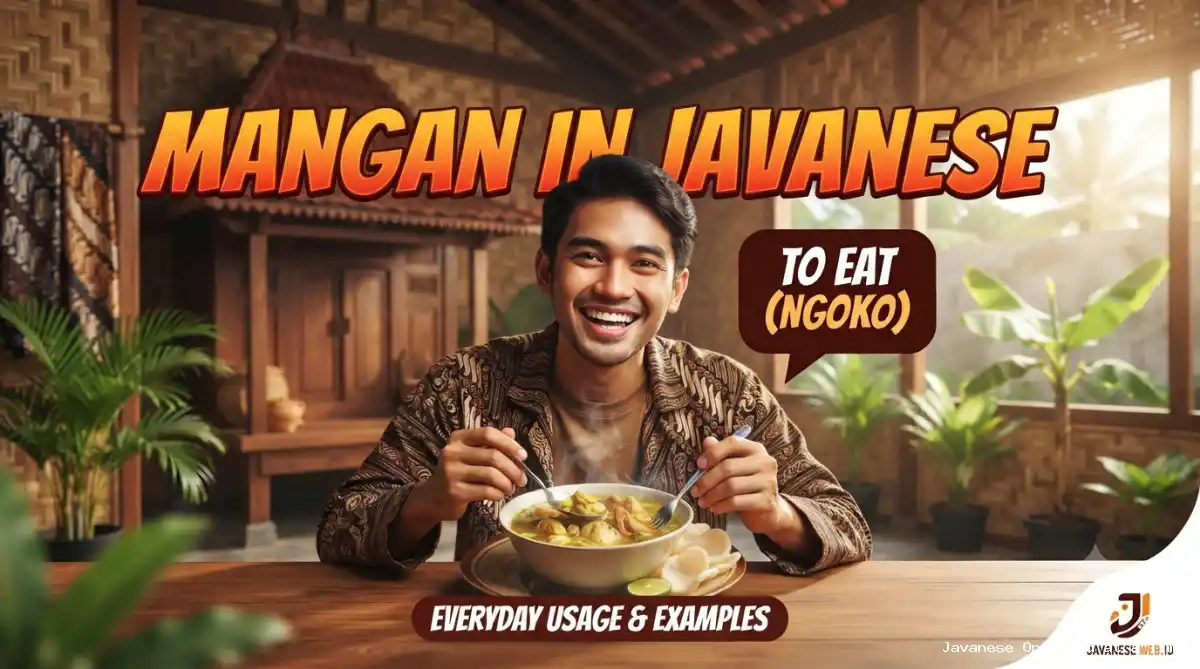
Learning Javanese one word at a time can reveal a lot about how the language works in everyday communication. One useful example is mangan, a common Javanese word related to eating.
For international learners, however, knowing the English translation alone is not enough. The way mangan is used depends on the sentence, the relationship between speakers, and the speech level being used.
In this article, we will look at what mangan means, how it is used, and what learners should understand about its social context.

What Does “Mangan” Mean?
Javanese:
mangan
Natural English meaning:
to eat / eat
At its most basic level, mangan refers to the action of eating. It can appear in everyday sentences about meals, asking whether someone has eaten, or talking about what someone is doing.
For example:
Aku mangan.
A natural English translation is:
I am eating.
Depending on context, mangan can also be understood simply as eat or to eat rather than requiring one fixed English translation.
It is therefore important to look at the complete sentence rather than translating the word mechanically.
Literal vs. Natural Meaning
The meaning of mangan is relatively straightforward because its literal meaning and everyday meaning are closely connected.

Literal meaning: eating / to eat
Natural meaning: eat, to eat, or am eating, depending on the sentence and context.
For example:
Aku arep mangan.
This can naturally be translated as:
I want to eat.
or, depending on the context:
I’m going to eat.
The word mangan itself refers to eating, while the surrounding words provide additional information about the speaker’s intention or situation.
When Do Javanese Speakers Use This Expression?
Mangan is used in ordinary conversations when speakers talk about eating or meals.
It may appear when someone asks whether another person has eaten, explains what they are doing, or talks about plans involving food.
Here are some simple examples:
1. Aku mangan.
English: I am eating.

Context: A speaker can use this sentence to tell someone that they are eating.
2. Aku arep mangan.
English: I’m going to eat.
Context: The speaker is expressing an intention or plan to eat.
3. Wis mangan?
English: Have you eaten?
Context: This is a short everyday question about whether someone has already eaten.
The exact social meaning of a sentence can depend on who is speaking to whom and the wider conversation.
Javanese Speech Level and Politeness
One important point for learners is that mangan is associated with Ngoko usage.
Javanese has different speech levels, and word choice can change depending on the relationship between speakers and the level of politeness required.
Because of this, learners should not assume that mangan is appropriate in every situation.
In an informal conversation between people who are comfortable using Ngoko, mangan can be completely natural. However, when speaking to someone who should be addressed more respectfully, Javanese speakers may choose vocabulary appropriate to a more polite speech level.
This is one reason why learning individual Javanese words together with their social context is important.
The appropriate choice is not determined only by the English meaning of a word. It also depends on the relationship between the people communicating.
Examples in Context
Here are several examples showing how mangan can appear naturally in sentences.
Example 1: Talking about an activity
Aku lagi mangan.
Natural English: I’m eating right now.
Context: The speaker is explaining what they are currently doing.
Example 2: Talking about a plan
Aku arep mangan dhisik.
Natural English: I’m going to eat first.
Context: The speaker indicates that eating will happen before another activity.
Example 3: Asking about someone
Kowe wis mangan?
Natural English: Have you eaten?
Context: This is an informal question between people using Ngoko.
Example 4: Talking about food
Aku mangan sega.
Natural English: I eat rice.
Context: The sentence identifies what the speaker is eating. The exact English tense can depend on the surrounding context.
These examples demonstrate why mangan should not always be translated using one fixed English form. English uses grammatical structures such as tense and auxiliary verbs differently from Javanese.
Common Mistakes Learners Should Avoid
A common beginner mistake is assuming that knowing the meaning of mangan automatically tells you when it is socially appropriate.
It does not.
Learners should pay attention to speech level. Using a familiar Ngoko word with someone who expects a more respectful form can sound inappropriate even when the basic meaning is correct.
Another mistake is translating every occurrence of mangan as exactly “eating.” The best English translation depends on the rest of the sentence.
For example, mangan can correspond to eat, to eat, or eating in different English translations.
Cultural Context
Food and eating naturally appear frequently in everyday conversation, so vocabulary related to eating is useful for anyone learning conversational Javanese.
However, it is better not to attach an invented cultural meaning to mangan. The word itself simply relates to eating. Its broader social meaning comes from the sentence, the relationship between speakers, and the speech level being used.
For learners, the most useful cultural lesson is therefore to understand that Javanese communication pays attention not only to what is being said but also to how it is said and to whom.
Short Conversation
Here is a simple informal conversation using mangan:
A: Wis mangan?
B: Durung. Aku arep mangan saiki.
English Translation:
A: Have you eaten?
B: Not yet. I’m going to eat now.
This conversation uses everyday Ngoko-style vocabulary. The speakers are talking informally, and the choice of mangan fits that context.
Related Expressions
Once you understand mangan, you can recognize it in many sentences related to eating.
For example:
- lagi mangan — eating / currently eating
- arep mangan — going to eat / intending to eat
- wis mangan — have eaten / already eaten
- durung mangan — have not eaten yet
- mangan sega — eat rice
These combinations are useful because they show how the basic word changes meaning when combined with other words.
Final Takeaway
Mangan is a basic and useful Javanese word meaning “to eat” or “eat.” Its literal meaning is closely connected to its everyday meaning, but its English translation can change according to the sentence.
For international learners, the most important point is that mangan is associated with Ngoko, so its suitability depends on the social situation and relationship between speakers.
Learning mangan is therefore more than memorizing the English word “eat.” It is also an opportunity to begin understanding how Javanese vocabulary, sentence context, and speech levels work together in everyday communication.