Javanese script history reflects a long development of writing traditions in Java. The script known today as Javanese script is connected to older writing systems and has undergone changes in form and use over different historical periods. Its development is also closely associated with Javanese literature, cultural traditions, and stories surrounding the legendary figure Aji Saka.
Today, modern Javanese script remains an important part of Javanese cultural heritage, particularly in areas where Javanese language and traditions continue to be practiced.
Background: The Origins of Javanese Script
The history of Javanese script can be understood through the development of several related writing traditions. The material describes Javanese script as an abugida, a type of writing system in which consonant characters carry an inherent vowel sound that can be modified.

The script is described as having roots connected to the Brahmi family of writing systems. Earlier forms were used for writing several languages and literary traditions, including Javanese, Makassarese, Sasak, and Sundanese.
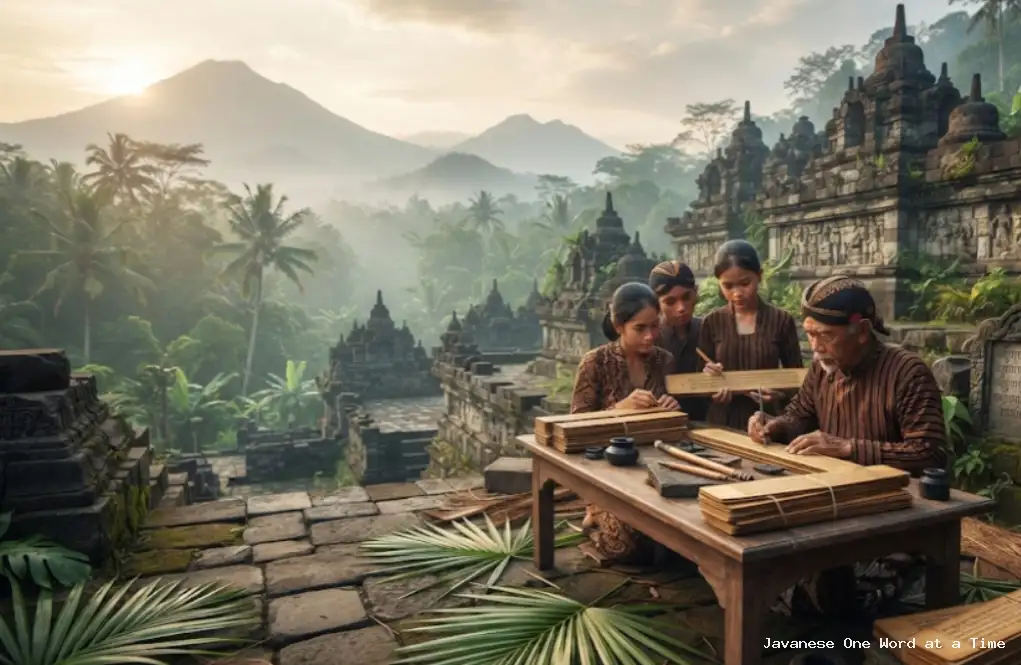
One important predecessor was Kawi script, an older writing tradition associated with Java and the wider region. According to the material, Kawi writing was used from approximately the eighth century through the sixteenth century.
The modern form of Javanese script developed later. The material associates its development with the Mataram Sultanate in the seventeenth century, while printed forms appeared during the nineteenth century.
This development means that the script used today should not simply be treated as identical to the older Kawi writing system. Instead, modern Javanese script represents a later form that developed from earlier traditions.
Javanese Script History and the Kawi Tradition
The distinction between Kawi and modern Javanese script is important when discussing Javanese script history.
The material identifies two broad forms: ancient Kawi writing and modern Javanese script. Kawi was associated with an earlier period, while the modern system developed through subsequent changes in Javanese writing practices.
The early period described in the material predates the widespread arrival of Islam in Java. This period is referred to as the Hindu Javanese period. At that time, the writing system followed principles associated with the Sanskrit Panini system.
The ordering of characters is also significant. The traditional sequence ka-ga-nga is mentioned as an example and is also reflected in the ordering used for Javanese script in Unicode.
However, the system of character distinctions was not identical to the one found in modern Javanese writing. For example, the material notes that the earlier period did not yet have the distinction of murda characters as found in the modern system.
These differences demonstrate that Javanese writing has changed over time rather than remaining completely fixed.
The Islamic Period and the Development of Modern Javanese Script
Another stage in the history of Javanese script is associated with the Islamic period in Java. According to the material, this period contributed to the development of what became the modern Javanese script.
Written works and literary traditions played an important role in this development. The material specifically mentions texts associated with Suluk Wijil and Serat Ajisaka.
Javanese writing was creatively organized in ways that could make the characters easier to remember and more appealing. At the same time, literary traditions surrounding the script included stories and myths that became closely associated with Javanese cultural understanding of the writing system.
One of the best-known stories connected with the characters is the legend of Aji Saka and his two servants, Dora and Sembada.
The Aji Saka Story Behind Ha Na Ca Ra Ka
The sequence Ha Na Ca Ra Ka is traditionally associated with the story of Aji Saka. In the account presented in the material, Aji Saka left Majethi for Medhangkamulan, while Sembada remained behind to guard items entrusted to him, including jewelry and a sacred heirloom.
Later, Dora was sent to Majethi to retrieve the objects. Sembada refused to hand them over because he had been instructed not to give them to anyone other than Aji Saka himself.
The disagreement eventually became a confrontation between Dora and Sembada. Neither was able to defeat the other, and both died.
The traditional interpretation of the sequence is presented as follows:
- Ha Na Ca Ra Ka — there were messengers.
- Da Ta Sa Wa La — there was a dispute or confrontation.
- Pa Dha Ja Ya Nya — they were equally strong.
- Ma Ga Ba Tha Nga — they ended up dead or became corpses.
This story gives the sequence of Javanese characters a narrative dimension. Rather than being viewed only as a series of written symbols, the characters are also connected with a cultural story that has been transmitted through Javanese tradition.
It is important, however, to understand the Aji Saka account as a traditional legend associated with the script rather than automatically treating every part of the story as documented historical fact.
Cultural Meaning and Writing Practices
Modern Javanese script is not simply a collection of symbols used to represent sounds. The material also emphasizes that writing the script involves rules and cultural philosophy.
One traditional practice described in the source concerns the direction in which characters are written. Javanese script is said to be written beginning from the lower part and moving upward according to the particular structure of the character.
The material connects this practice with a philosophical interpretation involving respect for parents and the stages of human development.
Such interpretations demonstrate how writing can carry cultural meaning beyond its basic function as a communication system. In the Javanese context, script, literature, philosophy, and cultural traditions have often been discussed together.
Why Javanese Script Remains Important
The continuing recognition of modern Javanese script is significant for the preservation of Javanese cultural heritage.

For international learners, understanding Javanese script history can also provide useful context when studying the Javanese language. Learning the characters without understanding their historical development may make the writing system seem like an isolated alphabet. Looking at its development instead shows that the script is part of a much longer literary and cultural tradition.
The distinction between older Kawi forms and modern Javanese script is particularly important. It helps learners understand why historical manuscripts and modern examples of Javanese writing may not always look exactly the same.
At the same time, traditional stories such as the Aji Saka legend show how writing systems can become connected with cultural narratives and collective memory.
What Javanese Script History Tells Us About Javanese Culture
The development of Javanese script illustrates the relationship between language, writing, literature, and cultural change.
From earlier Kawi traditions to the modern script, Javanese writing has developed through different historical periods. The material highlights changes associated with both the pre-Islamic and Islamic periods and points to the importance of literary works in the development of the modern tradition.
The Aji Saka story adds another layer of cultural meaning. Through the characters Ha Na Ca Ra Ka, the writing system is connected with a story about loyalty, duty, conflict, and death.
Meanwhile, traditional interpretations of writing practices show that the physical act of writing can also be associated with values such as respect for parents.
For this reason, Javanese script can be studied not only as a writing system but also as an entry point into the broader history and cultural traditions of Java.
Conclusion
Javanese script history is shaped by the development of older writing traditions, including Kawi, and the emergence of the modern Javanese script. The material places important stages of this development in different historical periods, including the pre-Islamic and Islamic periods of Java.
The modern script also carries cultural associations beyond written communication. Literary traditions, the Aji Saka legend, the famous Ha Na Ca Ra Ka sequence, and traditional interpretations of writing practices all contribute to the cultural significance of Javanese script.
For anyone interested in the Javanese language and culture, learning about the history of its writing system provides a broader understanding of how language and cultural heritage have developed together over time.