
A single word can offer an interesting introduction to a language and the culture in which it is spoken. In Javanese, one such word is turu, a common word associated with sleeping.
For international learners, turu may seem straightforward because its basic meaning is easy to understand. However, learning a Javanese word is not only about finding its English equivalent. It is also useful to understand where the word fits in everyday communication and how Javanese speakers choose language according to social relationships and situations.
In many Javanese contexts, language is closely connected with social interaction. Speakers may adjust their vocabulary depending on who they are talking to, their relationship with that person, and the level of formality involved.
This makes turu an interesting starting point for learning not only a piece of Javanese vocabulary, but also the importance of context in Javanese communication.
WHAT IS “TURU”?
Turu means “to sleep” or “sleep” in Javanese.
It is commonly associated with Ngoko, the less formal level of Javanese generally used in familiar or informal interactions. For example, a speaker may use turu when talking with someone in a close or casual relationship.
A simple example is:
Aku turu.
“I sleep” or “I am sleeping.”
Here, aku means “I” and turu expresses the action of sleeping.
Another example is:
Aku arep turu.
“I am going to sleep.”
The word arep indicates intention or something that is about to happen, while turu identifies the activity.
For beginners, these short sentences demonstrate an important point: vocabulary cannot always be understood separately from the social setting in which it is used.
HISTORICAL OR CULTURAL BACKGROUND
There is no need to attach an elaborate historical origin story to turu in order to understand its cultural relevance. The word belongs to ordinary Javanese vocabulary and refers to a universal human activity: sleeping.
Its cultural interest comes more from how the word functions within Javanese communication.

Javanese is known for having different speech levels and choices of vocabulary that can reflect social relationships and degrees of politeness. Therefore, knowing that turu is associated with Ngoko is useful for learners.
This does not mean that the word should be treated as a complete representation of Javanese culture. Rather, it provides a small example of a broader feature of Javanese communication: the choice of words can matter socially as well as grammatically.
The everyday nature of turu is also significant. Sleep is part of ordinary life, so expressions involving sleeping can naturally appear in conversations about daily routines, tiredness, plans, family life, and other familiar subjects.
HOW IT IS UNDERSTOOD OR PRACTICED
The basic concept behind turu is simple: it refers to sleeping.
In everyday conversation, however, the meaning of an expression containing turu depends on the surrounding words and the situation.
Consider:
Aku turu dhisik.
“I’ll sleep first.”
The sentence can be used in a casual setting when someone wants to indicate that they are going to sleep before continuing an activity or conversation.
Similarly:
Wis turu?
“Have you slept?” / “Are you asleep?”
Depending on context, a short question involving turu can function as part of an ordinary conversation rather than as a formal statement about sleep.
For learners, this is an important lesson. Literal translation provides the basic meaning, but context helps determine what a speaker is actually communicating.
LANGUAGE AND CULTURAL CONNECTION
The connection between turu and Javanese culture becomes clearer when considering speech levels.
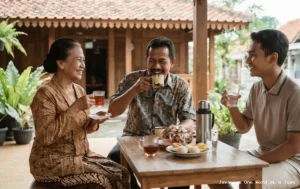
Javanese communication can involve choices associated with different levels of speech. Ngoko is generally connected with informal or familiar interaction, although actual usage depends on the relationship between speakers and the particular social context.
As a result, an international learner should not simply memorize turu as “the Javanese word for sleep” and use it in every situation without considering the listener.
This is especially important when speaking with people who are older, socially distant, or in a more formal relationship with the speaker. The appropriate vocabulary may differ depending on the speech level expected in that interaction.
The important point is not that one word is universally “correct” and another is universally “wrong.” Instead, Javanese learners need to develop an awareness of who is speaking to whom.
That social awareness is an important part of learning Javanese naturally.
SOCIAL CONTEXT
Because turu is associated with Ngoko, its use can suggest a familiar or informal conversational setting.
For example, friends or people who normally communicate using Ngoko may naturally use turu when talking about sleep. In a different social relationship, a speaker may choose different vocabulary appropriate to that situation.
This illustrates why learning Javanese requires more than memorizing vocabulary lists.
An English learner might learn one word for “sleep” and use it across many situations. In Javanese, the social relationship between speakers can influence which expression is appropriate.
However, it is important not to turn this observation into a rigid rule. Javanese is spoken by many communities, and actual language practices can differ according to region, family, age, social environment, and personal habits.
Therefore, turu should be understood as part of a flexible social language system rather than as a fixed cultural formula.
REGIONAL OR MODERN PERSPECTIVES
Javanese is spoken across different areas, and varieties of the language may differ in vocabulary, pronunciation, and usage. Modern communication also creates new environments in which Javanese is used alongside Indonesian and other languages.
For younger speakers, for example, conversations may move between Javanese and Indonesian depending on the situation. Digital communication, education, workplaces, entertainment, and friendships can all influence language choices.
Despite these changes, everyday words such as turu remain useful for understanding how Javanese can function in informal communication.
At the same time, learners should avoid assuming that every Javanese-speaking community uses the language in exactly the same way. A word that is familiar in one environment may have somewhat different patterns of use elsewhere.
WHY IT MATTERS TODAY
Learning a basic word such as turu may seem like a very small step, but it can introduce learners to a much larger principle: language is connected to social context.
For international learners, this is particularly valuable because translating individual words is not always enough to communicate naturally.
By learning turu, students can begin to notice questions such as:
- Who am I speaking to?
- Is this an informal or more formal situation?
- What speech level is appropriate?
- Does the surrounding sentence change the meaning?
- Is this expression commonly used in this particular community?
These questions make language learning more practical.
They also encourage learners to approach Javanese culture with curiosity rather than assumptions.
WHAT INTERNATIONAL READERS SHOULD KNOW
International readers encountering turu for the first time should remember three main points.
First, turu means “to sleep” and is an everyday Javanese word.
Second, it is generally associated with Ngoko, so its social suitability depends on the relationship between speakers and the situation.
Third, Javanese usage is not completely uniform. Regional differences, personal language habits, age, and changing communication environments can influence how people speak.
It is therefore better to learn turu together with its context rather than treating it as an isolated vocabulary item.
For a beginner, a useful starting sentence is:
Aku arep turu.
“I am going to sleep.”
The sentence is simple, but it demonstrates how a basic Javanese word can be connected to everyday communication and the wider structure of the language.
FINAL TAKEAWAY
Turu is a simple Javanese word meaning “to sleep,” but its use offers an important lesson for anyone learning Javanese.
The word is commonly associated with Ngoko and therefore belongs to a social system in which vocabulary can vary according to relationships and situations. Understanding this context helps international learners avoid treating Javanese as a language in which every English word has only one direct equivalent.
Most importantly, turu shows that even an ordinary everyday word can provide a window into how language works within society.
For learners of Javanese, starting with one familiar word at a time can be a practical way to build vocabulary while gradually developing an understanding of the language’s social and cultural dimensions.