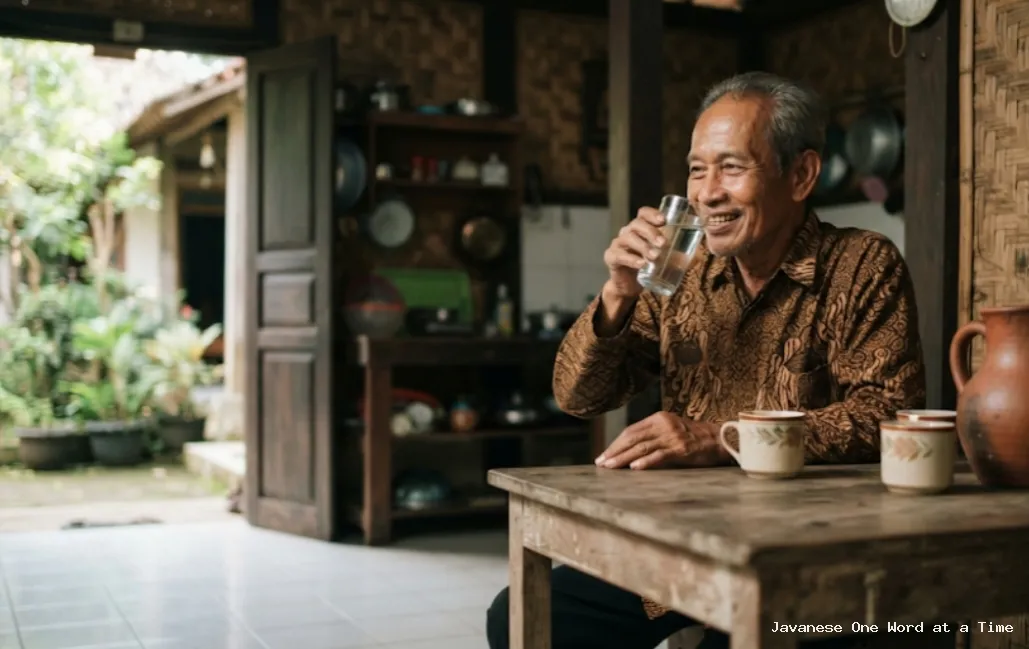
When learning Javanese, one useful way to understand grammar is to study how everyday verbs behave inside complete sentences. The word ngombe is a good example.
In everyday Javanese, ngombe means “to drink” or “drink.” It is commonly associated with Ngoko, the relatively informal speech level used in familiar or casual situations.
However, learning ngombe is not simply a matter of memorizing its English translation. The important point is understanding how the word functions as a verb and how it fits into a Javanese sentence.

For international learners, this provides a practical introduction to an important feature of Javanese: verbs can function naturally as the predicate of a sentence, while context and speech level help determine how the sentence should be expressed.
WHAT IS “NGOMBE” IN JAVANESE GRAMMAR?
Ngombe is a Javanese verb meaning “to drink.”
For example:
Aku ngombe banyu.
I drink water.
Here, aku means “I,” ngombe means “drink,” and banyu means “water.”
The verb does not need an English-style equivalent of “do” or an auxiliary verb before it. The basic verb can directly form the predicate of the sentence.
This makes ngombe particularly useful for beginners because it demonstrates a simple and common Javanese sentence structure.
The form ngombe is associated with Ngoko, so learners should pay attention to who they are speaking to and the social setting in which they use it.
HOW THE STRUCTURE WORKS
The simplest way to understand ngombe is to treat it as the main verb in a sentence.
Consider:
Aku ngombe.
I drink. / I am drinking.
The sentence has two basic parts:

- Aku — the subject, “I”
- ngombe — the verb, “drink”
Javanese does not require the verb to change simply because the subject is different in the way English verbs sometimes do.
For example:
Aku ngombe.
I drink.
Dheweke ngombe.
He/She drinks.
The verb remains ngombe.
This is an important point for English-speaking learners. You should not automatically try to create different forms such as an equivalent of drink, drinks, and drinking by changing the Javanese verb itself.
Instead, context and additional words can help communicate when an action happens.
SENTENCE PATTERN
A useful basic pattern is:
Subject + ngombe
For a sentence with an object:
Subject + ngombe + Object
Examples:
Aku ngombe banyu.
I drink water.

Dheweke ngombe kopi.
He/She drinks coffee.
You can also add information about time or place when necessary:
Subject + ngombe + Object + additional information
For example:
Aku ngombe teh ing omah.
I drink tea at home.
The exact arrangement of additional information can vary according to context and what the speaker wants to emphasize. Therefore, beginners should first become comfortable with the simple subject + ngombe pattern before trying more complicated sentence structures.
JAVANESE EXAMPLES
Here are several natural examples showing how ngombe can function in everyday Javanese.
1. Aku ngombe banyu.
English: I drink water.
Explanation:
Aku is “I,” while ngombe is “drink.” Banyu means “water.” This is a straightforward example of the subject–verb–object pattern.
2. Dheweke ngombe kopi.
English: He/She drinks coffee.
Explanation:
Dheweke refers to another person. The verb remains ngombe, regardless of whether the subject is “he” or “she.”
3. Aku arep ngombe.
English: I want to drink. / I am going to drink.
Explanation:
Here, arep expresses intention or a future-oriented action, while ngombe remains the main verb. This shows how another word can be placed before the verb to add meaning.
4. Kowe ngombe apa?
English: What are you drinking?
Explanation:
Kowe means “you,” while apa means “what.” The sentence asks about the thing being drunk. The question does not require an English-style auxiliary such as “do” or “are.”
5. Kowe wis ngombe?
English: Have you drunk yet? / Have you had something to drink?
Explanation:
Wis indicates that an action has already occurred or has been completed. The basic verb remains ngombe.
6. Aku ora ngombe kopi.
English: I do not drink coffee.
Explanation:
Ora is a common Ngoko negator. It appears before ngombe, creating a negative statement: ora ngombe means “do not drink” or “am not drinking,” depending on context.
These examples demonstrate an important principle: ngombe stays recognizable as the central verb while other words provide information about intention, completion, questioning, or negation.
COMMON MISTAKES
One common mistake among beginners is treating Javanese verbs exactly like English verbs.
For example, learners may expect ngombe to change according to the subject. In ordinary usage, however, you do not need to create separate forms equivalent to English drink and drinks simply because the subject changes.
Another mistake is using ngombe without considering speech level. A sentence can be grammatically understandable but socially inappropriate if the speaker uses an informal Ngoko form in a situation that calls for a more respectful register.
Learners should also avoid assuming that every Javanese sentence follows exactly the same word order as an English sentence. Basic patterns are useful, but real conversations allow variation depending on context and emphasis.
USAGE IN CONVERSATION
Because ngombe is an everyday verb, it can appear naturally in casual conversation.
For example:
A: Kowe wis ngombe?
B: Durung.
A: Ngombe dhisik.
A natural English interpretation is:
A: “Have you had something to drink?”
B: “Not yet.”
A: “Have a drink first.”
The important lesson is that conversational Javanese often relies on context. Speakers do not always need to express every detail explicitly when the situation already makes the meaning clear.
JAVANESE SPEECH LEVELS
Speech level is especially important when learning a word such as ngombe.
Ngombe is an informal Ngoko form. Ngoko is commonly used in familiar or informal interactions, although the appropriateness of a particular form depends on the relationship between speakers and the situation.
Javanese also has more polite speech forms. A commonly encountered polite counterpart for “to drink” is ngunjuk.
Therefore, learners should not think of ngombe as simply the one universal Javanese translation of “drink.” The appropriate vocabulary can depend on who is speaking, who is being addressed, and the level of respect required by the situation.
This is one reason that learning Javanese grammar also involves learning how speech levels affect vocabulary choice.
LEARNING TIPS
A simple way to remember ngombe is to learn it together with complete sentences rather than as an isolated dictionary item.
Start with:
Aku ngombe.
I drink.
Then expand it:
Aku ngombe banyu.
I drink water.
Next, practice changing the surrounding words:
Aku arep ngombe.
I want to drink.
Aku ora ngombe kopi.
I do not drink coffee.
Kowe wis ngombe?
Have you drunk yet?
This approach helps you see ngombe as a functioning verb rather than merely memorizing the English word “drink.”
It is also useful to remember that the verb itself does not carry all the information. Words such as arep, wis, and ora add important meanings around it.
FINAL TAKEAWAY
The word ngombe offers a simple but useful introduction to Javanese grammar.
It functions as a verb meaning “to drink” and can appear directly as the predicate of a sentence:
Subject + ngombe
It can also be followed by an object:
Subject + ngombe + Object
Additional words can express intention, completion, negation, or other contextual meanings. Most importantly, learners should remember that ngombe is associated with Ngoko, so speech level must be considered when choosing it in conversation.
For beginners, the best strategy is to practice ngombe through complete sentences such as Aku ngombe banyu, Aku arep ngombe, and Kowe wis ngombe? Once these patterns become familiar, it becomes easier to understand how Javanese verbs work naturally in everyday communication.