
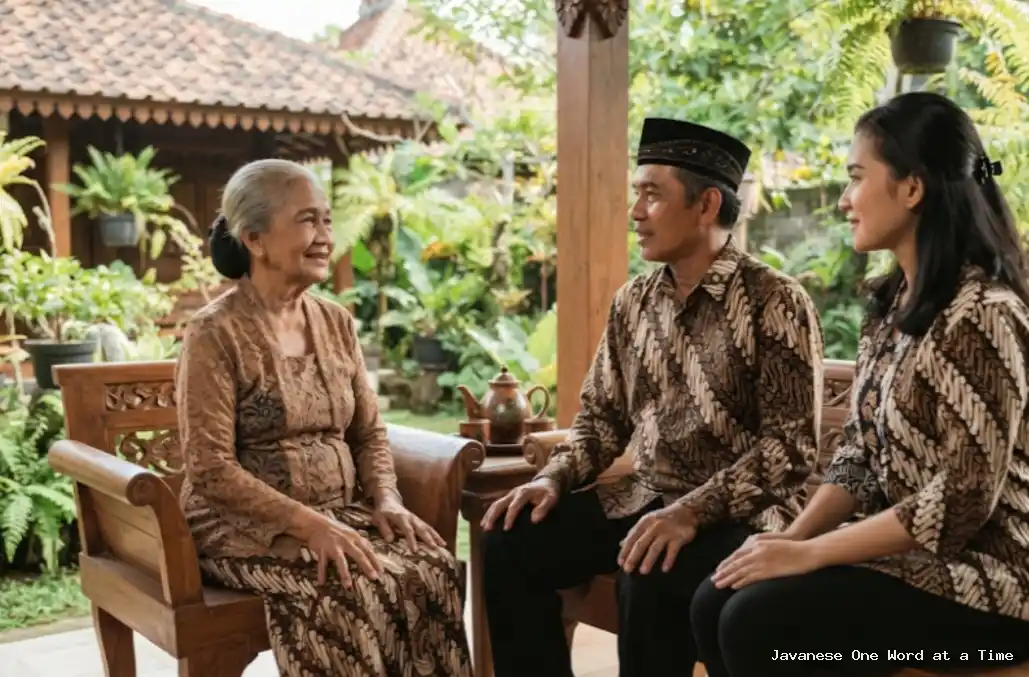
The Javanese language has several levels of speech that help speakers adjust the way they communicate with other people. Known as part of unggah-ungguh, or language etiquette, these levels reflect the relationship between the speaker and the person being addressed.
Among the commonly discussed levels are Javanese Ngoko, Madya, and Krama. Each has a different social function, ranging from informal communication between familiar people to more respectful speech used toward people who are less familiar or considered worthy of greater respect.
Understanding these levels is important for anyone learning Javanese because choosing a form of speech is not simply a matter of vocabulary. It can also communicate familiarity, distance, and politeness.

Background: Why Javanese Has Different Speech Levels
In everyday Javanese communication, speakers traditionally consider their relationship with the person they are talking to. Factors such as familiarity, social position, and the level of respect involved can influence the choice of speech level.
This system is generally associated with unggah-ungguh, a concept of appropriate conduct and etiquette in communication. One of its purposes is to help speakers communicate appropriately and avoid misunderstandings between people.
A discussion of these speech levels is also found in Tingkat Tutur Bahasa Jawa (2013), a work by Soepomo Poedjosoedarmo and colleagues.
Rather than treating all Javanese conversations as equally formal or informal, the system provides different ways for speakers to express social relationships through language.
Javanese Ngoko: Speech for Familiar Relationships
Javanese Ngoko is generally associated with a sense of closeness and a lack of social distance between speakers.
Because of this, Ngoko is commonly used when communicating with close friends and people of a similar age with whom the speaker has a familiar relationship.
However, its use is not limited to relationships between social equals. People with a higher social position may also use Ngoko toward someone in a lower position to express familiarity or a lack of distance.
For example, a teacher may use Ngoko when speaking to a student, while parents may use it when speaking to their children.
There can also be a more refined form of Ngoko in relationships where people are familiar with each other but still maintain mutual respect. The source material notes its use among groups such as civil servants, priyayi, and teachers.
This illustrates why simply describing Ngoko as “rude” would be misleading. Its meaning depends heavily on the relationship and situation in which it is used.
Javanese Krama: A More Respectful Level
At the other end of the commonly described spectrum is Javanese Krama.
Krama expresses a higher degree of politeness and is associated with a sense of respect or deference toward another person. It may be used when speaking to someone who is not yet familiar, someone considered authoritative, or someone with a higher social position.
The distinction is particularly visible in traditional family and educational settings.
According to the source material, many Javanese families have historically encouraged children to use Krama when speaking to their parents. Similarly, children in schools have been expected to use Krama when addressing teachers.
The purpose goes beyond vocabulary selection. Such practices have been connected with teaching children about manners, respect, and cultural etiquette.
For learners of Javanese, this means that Krama should not be understood simply as a collection of “formal words.” Its use is closely connected with how a speaker positions themselves in relation to the person they are addressing.
Javanese Madya: A Middle Level of Speech
Between Ngoko and Krama is Javanese Madya, a speech level associated with an intermediate degree of politeness.
Madya can be understood as occupying a position between the more familiar character of Ngoko and the stronger sense of respect associated with Krama.
The source material explains that Madya originally developed from Krama but underwent processes of informalization, lowering of level, and ruralization. As a result, Madya has often been perceived as being partly polite without carrying the same degree of social distance as Krama.
This intermediate position can make Madya difficult for beginners to understand.
It is neither simply “casual” nor fully equivalent to the most respectful speech. Instead, its social meaning depends on the circumstances and relationship between the people communicating.
Examples of Javanese Vocabulary
The differences between speech levels can also be seen through vocabulary.
Examples identified in the source material include the following.
Ngoko Examples
- Cangkem — mouth
- Weteng — stomach
- Mangan — eat
- Turu — sleep
- Tuwa — old
- Mlebu — enter
- Payu — sell / be sold
- Bungah — happy
- Tuna — loss
- Obah — change
These examples illustrate vocabulary associated with the Ngoko level described in the source.
Krama Examples
Examples given for Krama include:
- Dinten — day
- Sinten — who
- Mlebet — enter
- Mambet — smell
- Kawon — lose
- Majeng — advance / move forward
- Pajeng — sell / be sold
- Kajeng — wood
- Lemantun — cupboard
- Kantun — left behind
For learners, these forms demonstrate that changing speech level can involve using different vocabulary rather than merely changing pronunciation or adding a polite expression.
Madya Examples
The source also gives these examples of Madya vocabulary:
- Ampun — don’t
- Onten — there is / exist
- Ajeng — will / about to
- Awi — come / let’s come
- Ndika — you
- Ngadeg — stand
- Tebih — far
- Sade — sell
- Aos — value
- Amargi — because
These examples provide a basic illustration of the vocabulary associated with the intermediate level described in the source.
What the Three Levels Tell Us About Javanese Communication
The three levels demonstrate that Javanese communication involves more than conveying information.
A speaker’s choice of language can also indicate how close they feel to another person and how much social respect they wish to express.
Ngoko is associated with familiarity and reduced social distance. Krama communicates greater politeness and deference. Madya, meanwhile, occupies an intermediate position.
At the same time, these categories should not be treated as rigid rules that apply identically to every Javanese-speaking community. Actual language use can depend on the relationship, situation, speaker, and local patterns of communication.
This is particularly important for international learners. Memorizing vocabulary lists is useful, but understanding when and why a particular form is used is equally important.
Why These Speech Levels Matter for Learners
For someone beginning to study Javanese, learning the basic speech levels can provide useful cultural context.
A learner who knows only the literal meaning of a word may still have difficulty choosing the appropriate expression in a real conversation. The same communicative situation can require different vocabulary depending on who is speaking to whom.
The concept of unggah-ungguh therefore connects language learning with cultural understanding.
Learning these distinctions can also help international readers avoid assuming that one Javanese expression is universally appropriate in every social situation.
Instead, learners should pay attention to context and observe how native speakers communicate with different people.
Conclusion
The three commonly discussed Javanese speech levels—Ngoko, Madya, and Krama—show how closely language and social etiquette are connected in Javanese communication.
Ngoko generally expresses familiarity and a lack of social distance, while Krama conveys a higher level of politeness and respect. Madya occupies an intermediate position between the two.
These distinctions are more than vocabulary differences. They form part of the broader concept of unggah-ungguh, through which speakers adjust their language according to social relationships and circumstances.
For anyone learning Javanese, understanding these levels is therefore an important step toward using the language appropriately and appreciating the cultural values reflected in everyday communication.