In everyday Javanese, ngomong is a useful word for talking or speaking. For international learners, understanding ngomong is a good starting point for recognizing how Javanese speakers describe ordinary conversations and acts of speaking. The word is especially useful in informal situations, where natural and familiar expressions are common.
However, learning ngomong involves more than memorizing a single English equivalent. Its meaning becomes clearer when you see how it works in sentences, who you can use it with, and how it fits into the broader system of Javanese speech levels.
What Does “Ngomong” Mean?
Ngomong generally means “to speak,” “to talk,” or “to say” in English, depending on the context. It refers to the act of using spoken language to communicate with another person or express something.

For example, when someone says that another person is ngomong, the basic idea is that the person is speaking or talking. The exact English translation can change slightly according to the rest of the sentence.
In everyday communication, ngomong can be used when discussing a conversation, describing someone who is speaking, or referring to something that someone has said. Because of this flexibility, it appears naturally in many informal situations.
How to Pronounce “Ngomong”?
The word ngomong is written with the initial consonant combination ng, representing the sound heard at the beginning of words such as English sing when its final sound is brought to the beginning of a syllable.
A simple approximation for English speakers is ngoh-mong. The two parts can be practiced separately at first: ngo and mong. Then say them together naturally as ngomong.
As with many words from another language, listening to fluent speakers is the best way to develop a natural pronunciation. Learners should also avoid forcing an English pronunciation onto the word.
How Is “Ngomong” Used in Javanese?
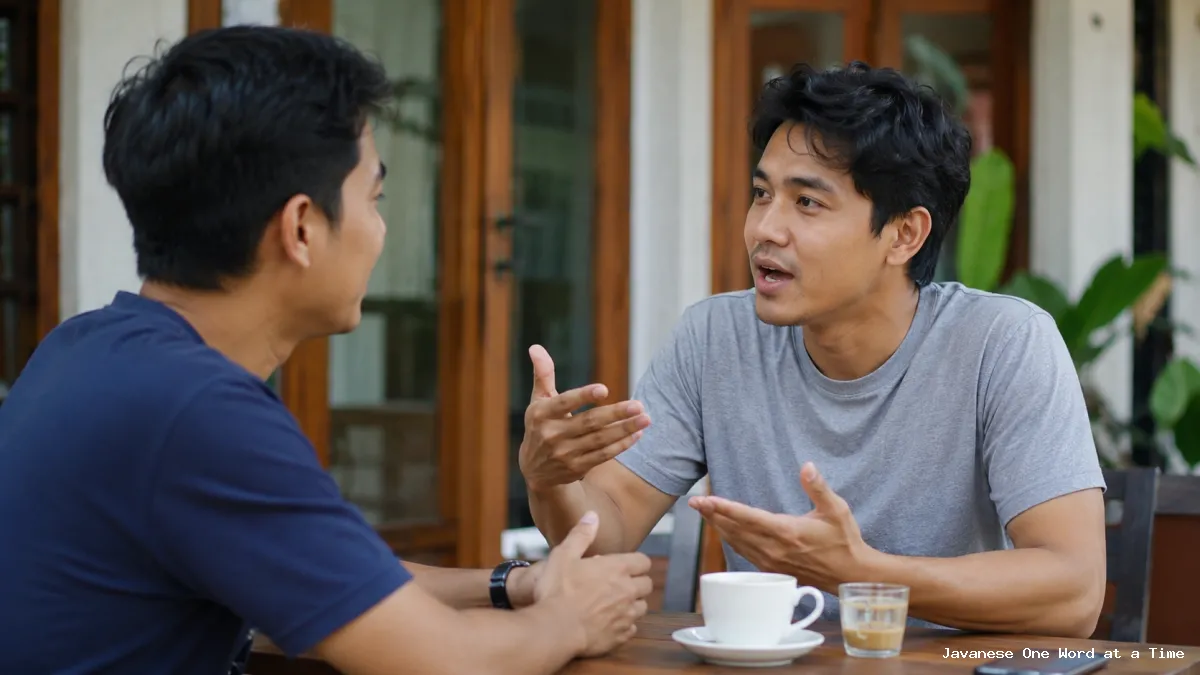
Ngomong is commonly associated with informal Javanese conversation. It can describe the simple act of talking to someone, saying something, or discussing a particular matter.
Its meaning is therefore closely connected to context. For instance, ngomong karo kanca refers to talking with a friend, while a sentence containing ngomong followed by a statement can indicate what someone said.
The word can also appear with other familiar conversational expressions. Rather than treating ngomong as a fixed dictionary entry, learners should pay attention to the whole sentence. This makes it easier to understand whether the intended meaning is closer to “talk,” “speak,” or “say.”
Javanese Examples with “Ngomong”
The following examples show how ngomong can function in simple everyday sentences.
Javanese:
“Aku arep ngomong karo kowe.”
English:
“I want to talk to you.”
Here, ngomong karo expresses the idea of talking with or to another person.

Javanese:
“Dheweke lagi ngomong karo kancane.”
English:
“He/She is talking to his/her friend.”
In this sentence, ngomong describes an action that is happening at the time being discussed.
Javanese:
“Aja ngomong banter-banter.”
English:
“Don’t speak too loudly.”
This example shows how ngomong can be used when giving a direct instruction in an informal setting.
These examples also demonstrate why context matters. The same Javanese word can be translated with different English verbs without changing its central idea of spoken communication.
Javanese Speech Levels and “Ngomong”
One important point for learners is that Javanese has different speech levels. Word choice can change depending on the relationship between speakers and the level of politeness required in a particular situation.
Ngomong belongs naturally to informal Javanese usage. It is therefore most comfortable in familiar, casual communication rather than situations where a highly respectful form of speech is expected.
This distinction is important for international learners because knowing what a word means is only part of learning Javanese. Knowing when it sounds appropriate is equally valuable.
For example, a learner might understand ngomong perfectly but still need to consider the person they are speaking to before using it. In Javanese, social context plays an important role in choosing appropriate language.
The Culture Behind the Word
The word ngomong does not need a complicated cultural explanation to be useful. Its importance comes primarily from its place in everyday spoken communication.
For learners, however, the word provides a useful introduction to an important feature of Javanese: speech is closely connected with social relationships. A simple idea such as “talking” can be expressed differently depending on the setting, the people involved, and the level of respect required.

That is why learning individual Javanese words together with their context is more useful than memorizing translations alone. Ngomong is a straightforward example of how vocabulary and social usage work together.
A Short Javanese Conversation
Here is a simple informal conversation using ngomong:
A: “Kowe arep ngomong apa?”
B: “Aku arep ngomong babagan kuwi.”
English Translation:
A: “What do you want to talk about?”
B: “I want to talk about that.”
This short exchange illustrates the conversational nature of ngomong. The word can be used naturally when one person asks about the subject of a conversation and another person explains what they want to discuss.
Related Javanese Words
When learning ngomong, it is useful to remember that Javanese vocabulary should not always be studied as isolated words. Words connected with speaking, conversation, and communication can help learners understand sentences more naturally.
For example, karo can appear with ngomong when identifying the person someone is talking with. The combination ngomong karo therefore provides a useful pattern for beginners to recognize.
Rather than memorizing many unrelated expressions at once, learners can start with the basic meaning of ngomong and then notice how it behaves in real sentences.
Remember This Javanese Word
Ngomong is a common informal Javanese word meaning “to talk,” “to speak,” or, in some contexts, “to say.” Its exact English translation depends on the sentence, while its informal character makes speech level an important part of using it appropriately.
For learners of Javanese, remember the central idea first: ngomong is about speaking or talking. From there, practicing it in short sentences and everyday conversations can make the word much easier to recognize and use naturally.