A simple everyday activity can reveal a great deal about a culture. In Javanese society, ngombe—the act of drinking—can be understood not only as a basic human need but also as part of ordinary social interaction.
The Javanese word ngombe generally refers to drinking. In everyday contexts, it can describe drinking water, tea, coffee, or other beverages. However, the activity itself can take on a wider cultural meaning depending on where, with whom, and in what situation it happens.
For international learners of Javanese, this makes ngombe an interesting topic. The word is simple, but the situations surrounding it can introduce learners to important aspects of everyday Javanese social life.
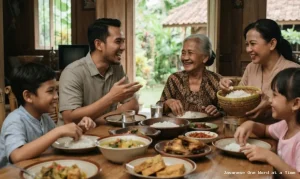
It is also important not to assume that every Javanese community has exactly the same customs. Drinking habits vary according to family, region, generation, religion, occupation, and individual preference. Therefore, ngombe is best understood as an everyday cultural activity with different expressions across Javanese communities.
WHAT IS “NGOMBE”?
Ngombe is a Javanese word meaning “to drink.” It refers to the action of consuming a liquid.
For example, someone may ngombe banyu, meaning “drink water.” A person might also talk about drinking tea or coffee in an ordinary conversation.
The word belongs to everyday Javanese vocabulary and is particularly useful for understanding informal speech. Like many Javanese words, however, its use should be considered together with the social situation in which it appears.
For learners, an important point is that ngombe is not automatically connected with alcoholic drinks. The word has a general meaning: drinking. Its specific meaning depends on the beverage and context being discussed.
This distinction matters because an international reader unfamiliar with Javanese culture might otherwise associate the word only with a particular type of drink.
In daily life, ngombe can involve something as ordinary as having a glass of water or drinking tea while talking with other people.
HISTORICAL OR CULTURAL BACKGROUND
Drinking is, of course, a universal human activity, so ngombe should not be treated as a uniquely Javanese behavior. What makes the topic culturally interesting is the way drinking can become connected with everyday social relationships.
In many Javanese contexts, offering food or drink to guests forms part of ordinary hospitality. A visitor may be offered something to drink when spending time in someone’s home or another social setting.
The exact beverage and manner of serving can vary considerably. Tea and coffee, for example, are familiar drinks in many parts of Java, while other traditional or locally available beverages may be encountered in different communities.
The broader cultural idea is therefore not that there is one fixed “Javanese drinking tradition.” Instead, drinking can become one of the small activities through which people welcome visitors, spend time together, or create a comfortable social atmosphere.
These practices should also be viewed historically with care. Contemporary Javanese drinking habits are influenced by changing lifestyles, commercial food and beverage culture, urbanization, technology, and generational preferences. Consequently, the way people experience ngombe today cannot necessarily be assumed to be identical to practices in earlier periods.

HOW IT IS UNDERSTOOD OR PRACTICED
At its most basic level, ngombe is simply drinking.
Yet everyday situations can give the activity additional social significance. Consider a person visiting a Javanese household. Offering a drink may be a practical response to the visit, but it can also function as a gesture of welcome.
Similarly, drinking together can create an opportunity for conversation.
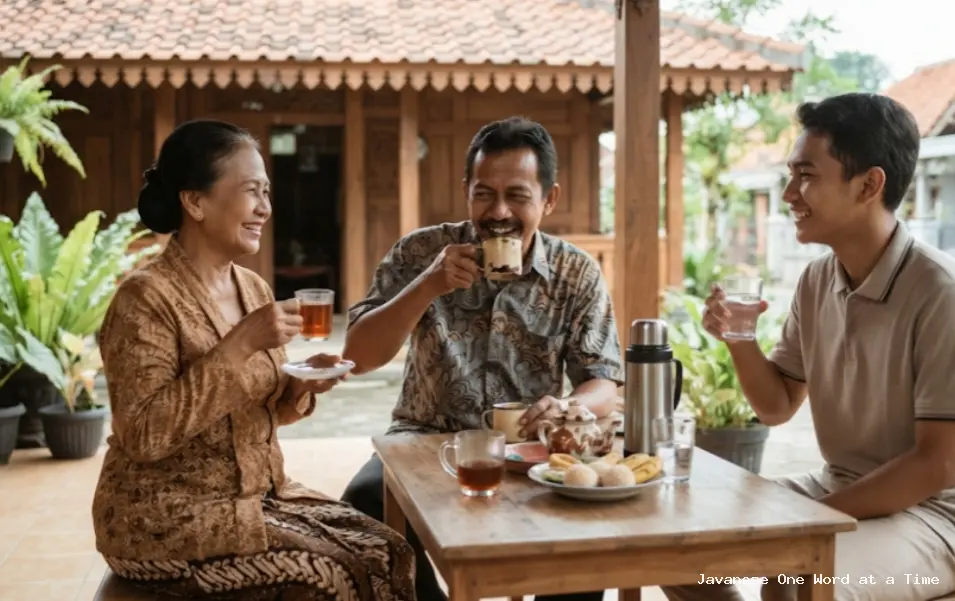
People may sit together while drinking tea or coffee, talk about daily activities, exchange news, or simply spend time in one another’s company. In such situations, the beverage itself may not be the main point. The shared moment can be just as important.
This does not mean that every act of drinking in a Javanese setting is a social ritual. Someone drinking water alone is simply meeting a basic need. The cultural dimension becomes more visible when ngombe occurs within a particular social relationship or setting.
For this reason, international readers should avoid looking for a single ritualized meaning behind the word. Ngombe can be completely ordinary while still appearing within culturally meaningful situations.
LANGUAGE AND CULTURAL CONNECTION
The connection between ngombe and Javanese culture becomes especially interesting when learners consider how the word functions in conversation.
Ngombe belongs to everyday Javanese vocabulary. It can appear in sentences concerning what someone is drinking, whether someone wants a drink, or what people are doing.
For example:
- Aku ngombe banyu. — “I am drinking water.”
- Ngombe teh. — “Drink tea” or “drinking tea,” depending on context.
- Wis ngombe? — “Have you had something to drink?” or, depending on context, “Have you drunk?”
These examples illustrate an important feature of learning Javanese: individual words become much more meaningful when studied in real conversational contexts.
Javanese also has different speech levels and registers. Therefore, learners should not assume that learning one everyday form automatically tells them every possible way to express the same idea in every social situation.
The culturally appropriate expression can depend on who is speaking to whom and the relationship between the speakers.
For international learners, this is one reason why vocabulary should be studied alongside social context rather than as isolated dictionary entries.

SOCIAL CONTEXT
The social side of ngombe can be particularly visible in hospitality.
In many Javanese contexts, a guest may be offered something to drink. This does not necessarily represent a formal ceremony. It can simply be part of making someone feel welcome.
A drink can also provide a natural reason for people to sit down and talk.
For example, friends, relatives, neighbors, or colleagues may spend time together over tea or coffee. In this situation, ngombe becomes connected with conversation and companionship.
However, the social meaning should not be exaggerated. Not every Javanese person considers drinking together an important cultural event, and not every household follows the same patterns of hospitality.
The most useful way to understand the practice is to see it as one possible part of everyday social interaction.
The setting matters as well. Drinking at home, in a workplace, at a food stall, in a café, or during a gathering can involve different expectations and habits.
REGIONAL OR MODERN PERSPECTIVES
Java is culturally diverse, and Javanese-speaking communities are not completely uniform. Drinking habits can differ between regions and between urban and rural environments.
The beverages that people commonly consume may also change according to local availability and contemporary lifestyles.
Modern life has introduced many new places and situations for ngombe. People may drink at traditional food stalls, modern cafés, restaurants, workplaces, schools, or while traveling.
At the same time, familiar habits such as drinking tea or coffee in a social setting continue to exist in many communities.
Generational differences can also influence how people drink and socialize. Younger people may encounter drinking culture through cafés, social media, contemporary food trends, and commercial beverage brands, while older generations may have different routines and preferences.
These developments show that culture is not static. The word ngombe remains an ordinary part of the language even as the environments in which people use it continue to change.
WHY IT MATTERS TODAY
Studying ngombe can help international learners understand an important principle in learning Javanese: language and culture are closely connected, even when the vocabulary appears simple.
A learner who knows that ngombe means “to drink” has learned a useful word. But a learner who also understands how drinking can occur within hospitality, conversation, and everyday social interaction has gained a broader understanding of how the word exists in real life.
This approach also prevents cultural stereotypes.
Rather than saying that Javanese people “always” drink together or “always” offer particular beverages to guests, it is more accurate to recognize these as practices that may occur in particular communities and situations.
The same principle applies to the beverages themselves. Tea, coffee, water, and other drinks may appear in different contexts, but no single beverage should automatically be treated as representative of every Javanese person.
For modern learners, this balanced perspective is especially valuable. It allows them to appreciate cultural patterns without turning those patterns into rigid rules.
WHAT INTERNATIONAL READERS SHOULD KNOW
There are several useful points for international readers learning about ngombe.
First, ngombe simply means “to drink.” It should not automatically be interpreted as referring to alcohol.
Second, drinking can sometimes have a social dimension. In many Javanese contexts, offering a drink to a guest can be part of everyday hospitality.
Third, drinking together may create an opportunity for conversation and social interaction, but it does not necessarily constitute a formal cultural ritual.
Fourth, Javanese communities are diverse. Practices involving drinks can vary according to location, family, generation, social setting, and individual preference.
Finally, language itself carries social information. Learning ngombe is therefore not only about memorizing a translation. Learners should also pay attention to the register, relationship between speakers, and situation in which Javanese expressions are used.
Understanding these distinctions can help international readers interact more naturally with Javanese speakers and avoid assuming that one cultural pattern applies everywhere.
FINAL TAKEAWAY
Ngombe is a simple Javanese word for “to drink,” but its everyday use opens a small window into Javanese social life.
Drinking can be an ordinary personal activity, yet it can also occur within hospitality, conversation, and shared moments with other people. In many Javanese contexts, offering or sharing a drink can contribute to a welcoming social atmosphere.
At the same time, there is no single way to understand drinking across all Javanese communities. Regional differences, family habits, social circumstances, and changing lifestyles all matter.
For international learners, this is perhaps the most useful lesson. Ngombe is not merely vocabulary. It is an example of how an ordinary action can become connected with relationships, communication, and cultural context.
By learning the word together with the situations in which it is used, learners can move beyond literal translation and begin to understand how Javanese works as a living language within everyday life.